 5 min read
Space: the final frontier. For perfumers, it represents a dreamy landscape often visited, especially since the advent of the space race. Perfumes have been inspired by flowers that only bloom under the stars at night and by myths of the moon and the stories of the stars across various cultures and eras. As the crew of Artemis IIreturns home, everyone wonders about the scent of space, a question queried after every successful mission since we first left the Earth’s surface.
Former NASA astronaut Greg Chamitoff remarked, “There’s a unique smell up here… We just call it the smell of space. It has this really strong metallic odor, and its origin is uncertain.” After extensive research spanning years, there is still no consensus on what it precisely is!
While space itself is odorless, at least to humans who wouldn’t survive long in a vacuum without a spacesuit, astronauts have described the lingering smell upon removing their helmets: the scent of ozone, the tang of gunpowder—metallic odors coming from their gloves and tools. To some, it is surprisingly similar to gourmet flavors. ESA astronaut Alexander Gerst described it as a mix of walnuts and motorcycle brake pads. In 2003, astronaut Don Pettit likened it to “sweet-smelling welding fumes,” reminiscent of his welding-filled summers.
Such a distinct olfactory array led NASA in 2020 to enlist a professional nose to recreate the smell. After gathering insights from numerous astronauts, NASA provided the notes to Steven Pearce of Omega Ingredients, who attempted to create an accurate representation. The goal was to disperse the fragrance in training simulations, so future astronauts would recognize the scent upon reaching space, and be aware of what they were smelling.
Olfactory training is a critical component in space exploration. NASA employs a chief sniffer and odor panel whose task is to scent everything that is launched into space, ensuring materials won’t become enduring irritants—since astronauts can’t exactly ventilate the space station. “Our initial detection system is our own sense of smell. Even though we collaborate with companies and have specific detectors on board,” Susanne Harper states, “ultimately, we recognize that human olfaction is our most sensitive alarm for detecting hazardous odors.” Harper heads the Materials Testing Program; all items destined for space are vetted through this program first.
Both the materials destined for space and the odor panelists undergo thorough testing to catalog their detection thresholds and scent levels. Because while many of us Earth-dwellers ponder the fragrances above, astronauts are dedicated to setting records, and any distraction that might precipitate an olfactory migraine hinders scientific progress. Such testing is vital, yet it does not obviate every unpleasant surprise; there was a pervasive scorching odor on Artemis II due to the $23 million defective space toilet. (Fortunately, astronaut Christina Koch was able to diagnose some issues while floating in zero gravity. What can’t women accomplish?)
So how do these astronauts, like Koch, prepare for the extraterrestrial bouquets? The commissioned fragrance, now available as Eau de Space, smells perhaps more familiar than anticipated. There are hints of metal, ozone, flames, gunpowder, biscuits, rum, and raspberries. The reviews are largely negative; it’s not exactly fashionable for many individuals to wear. In its favor, it accurately represents the odors that science has thus far chronicled. In addition to interviews with astronauts, spectrographic analysis of the molecular cloud Sagittarius B2—closer to the galactic core—found substantial ethyl formate. This molecule is also abundant closer to home. It happens to be what imparts raspberries their flavor, and it smells much like rum. The materials constituting stellar matter light-years away sometimes resonate in our everyday human lives. Earth, our home, and everything on it are ultimately composed of stellar essence.
Different regions of space, like the diverse atmospheres of interstellar objects, planets, and dark matter, are primarily composed of ammonia, formaldehyde, rotten-egg sulfur, and soot. Not quite a fresh-scent perfume. This is the essence of stars burning many thousands of degrees hotter than any earthly experience, matter so potent that the smallest particle is deemed explosive, a tool of comic-book villains and planetary detonations. It is not an amiable or tender fragrance. Various scientists have elaborated on how the aromas of different planets and parts of space differ: collectively, they are malodorous and likely unpleasant for our delicate human noses.

Eau de Space smells more familiar than you’d expect: there are hints of metal, ozone, flames, gunpowder, biscuits, rum, and raspberries. The reviews are largely negative—it’s not exactly wearable for many people.
Other perfumers have honored the stars in their own styles, from literary to direct scientific interpretations. CB I Hate Perfume’s 311 the Distance of the Moon draws on Italo Calvino’s tale about the moon, and it’s an enigmatic mix that is both estranging and comforting. Alkemia Perfume’s the Center of the Universe is a more literal tribute to the spectrographic data I mentioned and the diverse astronaut interviews. As a result, it smells like a peculiar party: raspberries and rum, welded metal and seared steak, almonds and walnuts, and ozone.
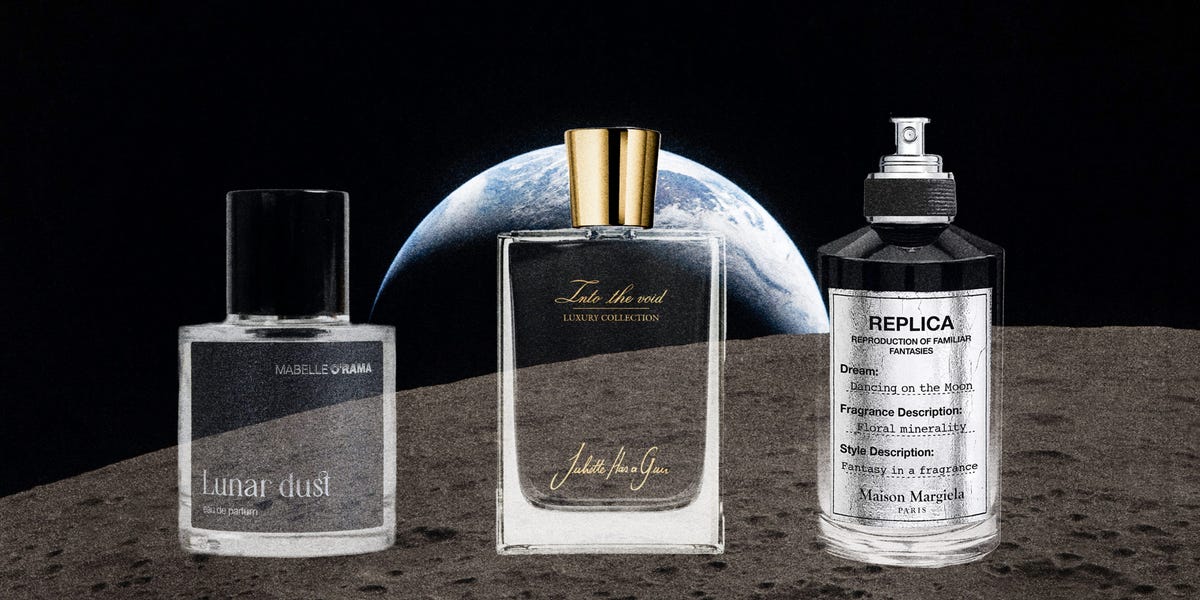
Replica by Margiela’s Dancing on the Moon is another interpretation. It has that cold, metallic ozone scent, aldehydes, and iris; it smells clean like sterile medical equipment, which seems fitting for the mission. There’s the award-winning Lunar Dust by the Lebanese-British brand Mabelle O’Rama, a sensual, powdery iris-and-white-wood composition. Perhaps the most luxurious take on space is Juliette Has a Gun’s Into the Void. Inspired by the gravitational pull of black holes, it’s meant to capture the enigma, darkness, and depth of the unknown. This is accomplished with a blend of licorice, orchid, tonka, ambroxan, guaiac wood, and cedar. While it might not hewing closely to the source material, it’s a sensual, sexy fragrance that won’t make people think you smell like a steak or welding metal.
Space is ultimately terrifyingly vast. You and I are mere specks on one planet in one solar system amidst hundreds of billions of systems in just the Milky Way. I’m certain the final frontier encompasses some stars that smell like an ambroxan bomb somewhere. In a galaxy far, far away, we’ll need to keep exploring to confirm.
More Space-Inspired Perfumes